/AEO
AEO vs SEO: what actually changes for a B2B SaaS company
October 1, 2026
Free AI visibility audit: see what ChatGPT tells your buyers about you →
Get it free
/AEO
October 1, 2026
AEO and SEO share most of the work: crawlable pages, clear answers, authority. What changes is the goal (being named inside an AI answer, not just ranked), where mentions matter (lists, directories, reviews), and how you measure (share of answers across engines, not only rankings).
So AEO is not a new discipline that replaces SEO. It is SEO with a second scoreboard. This guide shows what stays the same, what changes for a B2B SaaS company, and how to split the first 90 days. If you are new to the term, start with what AEO is.
Google says you need nothing special. Its guidance is that no extra requirements or special optimisations are needed to appear in AI Overviews and AI Mode. A page must be indexed and allowed to show a snippet. That is all.
Google's AI optimization guide goes further. It calls optimising for generative AI search "still SEO". It says llms.txt files, special markup and content chunking are not needed for its AI features.
Google also warns against scaled content abuse and asks for helpful, people-first content. Mass-produced pages written "for AI" go against that.
Some AEO tool vendors frame AEO as a separate field. For Google's own AI features, Google disagrees. Both views hold a piece of the truth, and the rest of this page shows where each one applies.
The base stays the same. The goal, the sources that matter and the scoreboard change. This table sets them side by side.
| Area | SEO | AEO | What a B2B SaaS team should do |
|---|---|---|---|
| Goal | Rank a page and win the click | Get your company named and cited inside the answer | Track both: rankings and how often answers name you |
| What the buyer types | Short keywords | Full questions, often with context ("for a Series A SaaS") | Build a list of the questions buyers ask before a demo |
| What the engine does | Ranks pages | Runs its own searches, reads pages, writes one answer | Make each page answer one question plainly in its first lines |
| Where mentions come from | Your pages and the links to them | Your pages plus lists, directories, reviews and community threads | Earn honest mentions on the sites engines read |
| Pages that matter most | Category and blog pages | Pricing, comparisons, use cases, "best X" lists, case studies | Put prices, proof and "who this is for" in plain text |
| Technical base | Crawlable, indexed, fast | Same, plus AI crawlers allowed | Check robots.txt allows search bots such as OAI-SearchBot |
| Clicks | Clicks are the main result | Many answers end without a click | Measure mentions and pipeline, not only traffic |
| Scoreboard | Rankings, clicks, Search Console | Share of answers by engine, with the questions behind it | Report both in one monthly view |
The click row matters most for a SaaS team. 68.01% of US Google searches ended without a click (Jan to Apr 2026), up from 60.45% in 2024. And when Google shows an AI summary, users clicked a result in 8% of visits with an AI summary vs 15% without; 1% clicked a link inside the summary.
So a page can do its job without a visit. If the answer names you and the buyer books a demo later, traffic reports will miss it. That is why the scoreboard has to change.
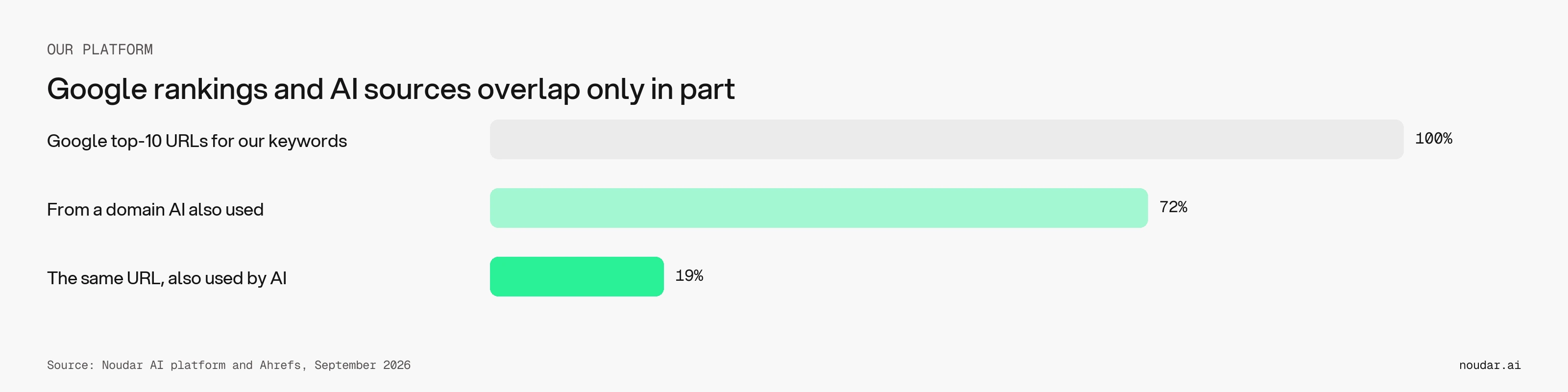
Partly. From our platform, AI engines often used the same sites that rank on Google, but usually not the same pages.
Our platform compared Google's top 10 for our target keywords with the sources ChatGPT and Perplexity used for our buyer questions. 19% of the Google top-10 URLs were also used by AI; 72% came from a domain AI also used.
Read this as indicative. The keywords and the questions were different sets, so it means "same sites, often different pages". It is not a precise overlap rate.
The two engines also lean on different kinds of sources. Our platform found that, across all our buyer questions, 45% of the links ChatGPT cited were directories and review sites such as Clutch and G2. Of the sources Perplexity read, most were guides and tools (35%), third-party lists (17%) and agency-written "best of" lists (16%).
The lesson: ranking on Google helps, because engines often read the same sites. But a good ranking alone will not get you named. You also need to show up on the lists and directories each engine reads.
Keep your SEO base and add three things: a question list, answer-ready pages, and mentions on the sites engines read.
1. Start from buyer questions, not only keywords. Write down the questions buyers ask when they are close to choosing. "Best [category] for a small sales team." "[You] vs [rival]." "How much does [category] cost?" These are the questions AI answers name vendors in.
2. Make your money pages easy to quote. Pricing, comparison, use-case and integration pages are what buyers read when close to choosing. Open each one with a plain answer. State who it is for, what it costs and what proof you have. One idea per paragraph, so an engine can lift it whole.
3. Earn mentions where engines look. Complete your Clutch or G2 profile with real reviews. Pitch honest data to the authors of third-party lists in your category. Join community threads openly, always saying who you are.
4. Watch the engines, not just Google. Ask your buyer questions in ChatGPT and Perplexity, a few times each. Note who gets named and which sources each answer uses. Then fix the gaps.
It depends on where you lose buyers today. This table is a starting point.
| Your situation | Better fit |
|---|---|
| Weak technical base, few pages indexed, little organic traffic | A SaaS SEO agency first. AEO needs this base |
| Good rankings, but AI answers name rivals and not you | An AEO-focused team that also covers mentions and lists |
| You need both and have a small team | One team that runs SEO and AEO end to end |
| You want only reports, not changes | A tracking tool may be enough |
Fix the base first, then build answer pages, then earn mentions. Most of your SEO work continues as it is. AEO adds a layer on top.
| Weeks | Keep doing (SEO) | Add (AEO) |
|---|---|---|
| 1 to 2 | Technical audit, indexing, core pages | Buyer question list; first check of who AI names; allow AI search bots; a 90-day plan ranked by impact |
| 3 to 4 | Technical fixes | First money pages rewritten answer-first; first pitches to third-party lists; directory profile updates. In week 4, ask every question again and re-rank the plan |
| 5 to 12 | Content on keywords with demand; internal links | New pages and upgrades every two weeks; more mentions; refresh what is not moving; a monthly report on answers and pipeline |
This is the order we follow in our own 90-day program.
Measure four layers: rankings, answers, visits and deals. Each one catches what the layer above misses.
The aim is one monthly view: what AI says about you, what visits it sends, and what pipeline follows. Visibility on its own is not the goal.
Treat them as hygiene, not levers. Valid schema and clean HTML help any crawler read your page. None of them is proven to get you named in AI answers.
We go through the evidence in do schema markup or llms.txt get you cited by ChatGPT?
We turn AI visibility into pipeline. Our free AI visibility audit asks your buyer questions in AI tools. We re-check every question, because AI answers change from one ask to the next. It shows the answers, who is named instead of you, the sources behind them and your top 3 blockers. Results in 12 hours.
Get your free AI visibility audit
If you want help with both SEO and AEO, our Design-Partner batch 1 has 3 spots, open until 31 Oct 2026. You pay EUR 1,500 at the start and EUR 1,500 at day 90. If we miss the goals agreed at kickoff, you get a full refund. A case study with us is part of the deal. We have no client case studies yet, which is why we offer these terms. See pricing
Mostly, yes. Google calls optimising for generative AI search "still SEO", and the base work is the same: crawlable pages, clear answers, authority. Two things are new. You need mentions on the lists, directories and review sites AI engines read, and you need to track how often each engine names you, not only rankings.
Not reliably. From our platform, 19% of the Google top-10 URLs for our keywords were also used by AI, while 72% came from a domain AI also used. So the engines often read the same sites, but usually other pages. Read this as indicative: the keywords and the questions were different sets.
No, but clicks are now a weak scoreboard. 68.01% of US Google searches ended without a click (Jan to Apr 2026), up from 60.45% in 2024. Users clicked a result in 8% of visits with an AI summary vs 15% without. A page can still win a buyer without a visit, so track mentions and pipeline next to traffic.
No, it adds a second list. Keywords still show demand on Google. AEO adds the full questions buyers type into AI tools, often with context, such as "best [category] for a Series A SaaS". Build that list from sales calls. Then ask each question in ChatGPT and Perplexity a few times to see who gets named and which sources each answer uses.
Usually not. Most SEO work pays off for both: technical fixes, indexing and strong money pages help Google and AI answers alike. AEO adds a layer on top: a buyer question list, answer-first rewrites of key pages, and mentions on lists and directories. If your technical base is weak, fix that first, because AEO depends on it.