/Services
GEO agency for B2B SaaS
October 1, 2026
Free AI visibility audit: see what ChatGPT tells your buyers about you →
Get it free
/Services
October 1, 2026

Generative engine optimization (GEO) is the work of getting your company cited and recommended in AI answers. Noudar AI does GEO and AEO as one programme for B2B SaaS. That means buyer prompts, pages AI can quote, mentions on the sources engines read, and pipeline reporting.
We turn AI visibility into pipeline.
Get a free AI visibility audit
Short answer: mostly, yes. The three labels cover nearly the same work. Agencies define them in different ways, so ask what tasks are included, not which label is used.
The term GEO comes from a 2023 research paper by Aggarwal et al. It reports visibility gains of up to 40% in generative engine responses. That was a lab study on test engines, not a field result, so treat it as a signal, not a promise.
| Task | GEO | AEO | AI SEO |
|---|---|---|---|
| Find the prompts buyers ask AI | Yes | Yes | Often |
| Make pages easy to quote (direct answers, tables) | Yes | Yes | Yes |
| Let AI search bots reach your site | Yes | Yes | Yes |
| Earn mentions on lists, directories, review sites | Yes | Yes | Sometimes |
| Track answers by engine and prompt | Yes | Yes | Sometimes |
| Classic SEO (rankings, links, technical) | Not always | Often | Yes |
Our view: call it what you like. What matters is that one team covers all six rows. For the longer version, read AEO vs GEO.
Short answer: ChatGPT leans on directories and review sites. Perplexity leans on guides, tools and "best of" lists. A GEO plan that treats them as one engine will miss half the work.
Our platform asks ChatGPT and Perplexity the questions buyers ask, with web search on, and sorts every source by type. Here is what it found in September 2026.
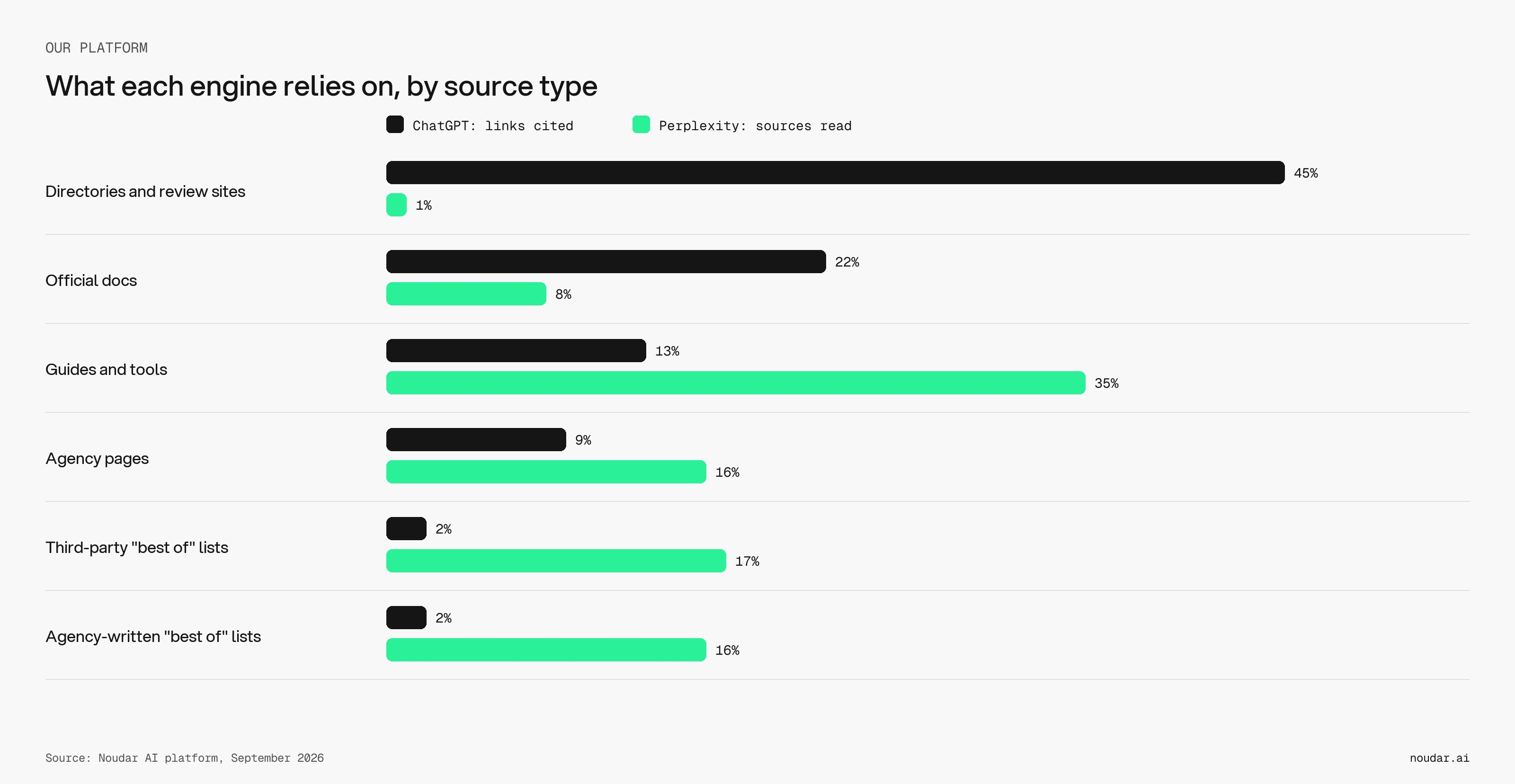
| Source type | ChatGPT (share of links cited) | Perplexity (share of sources read) |
|---|---|---|
| Directories and review sites (Clutch, G2) | 45% | 1% |
| Official docs | 22% | 8% |
| Guides and tools | 13% | 35% |
| Agency pages | 9% | 16% |
| Third-party "best of" lists | 2% | 17% |
| Agency-written "best of" lists | 2% | 16% |
Source: our platform, September 2026. For ChatGPT, shares of the links it cited. For Perplexity, shares of the sources it read, so don't compare the two columns as volumes.
On "which agency should I hire" questions, about half (49%) of Perplexity's sources were "best of" lists, many of them written by agencies. Our platform found that Perplexity named Omniscient Digital in 40% of its agency answers and Siege Media in 25%.
Your own site is only part of GEO. The lists and directories that cover your category shape the answer too. Our platform's answers are close to, but not the same as, what buyers see in the apps.
Short answer: five parts, run as one programme. Each one has a clear output you can check.
What we don't sell: schema and llms.txt as AI levers. They are hygiene. We set them up when useful, but we won't tell you they get you cited. Google says no special optimisations are needed to appear in AI Overviews and AI Mode.
Short answer: a fixed set of buyer prompts, re-checked in each engine every week and reported monthly. The method sits next to every number, and we connect it to pipeline.
| Part | What we do |
|---|---|
| Prompts | Your buyer prompts, grouped by topic and stage |
| Engines | ChatGPT, Perplexity and Google AI Overviews where they show, tracked apart |
| Re-checks | We re-check every question, because AI answers change from one ask to the next |
| Cadence | Re-checked every week, reported monthly |
| Output | Share of voice by topic and engine, with the date |
| Pipeline link | AI channel in GA4 custom channel groups, a "how did you hear about us?" field, and leads and deals in a monthly report |
This is the same method we use on ourselves. Our platform found that Noudar AI did not appear in any AI answer about agencies. We publish that because a GEO agency that hides its own baseline is asking you to trust numbers you can't check.
Short answer: maybe. If your SEO agency already tracks AI answers by engine and earns mentions off your site, it may be enough. If not, you need either a new skill set from them or a second team.
Ask your current agency these five questions:
| If the answers are... | Then |
|---|---|
| Clear on 1 to 4, "no" on 5 | Keep them. They already do GEO. |
| Strong SEO, weak on 1 to 3 | Add GEO with them or a partner. Agree who owns what. |
| Vague, or "yes" on 5 | Look for a team that does SEO and GEO as one plan. |
Switching has a cost: a new agency needs time to learn your product. Two agencies means two plans that can clash. We run SEO and GEO as one plan.
Short answer: EUR 3,000 for a 90-day programme, in two payments. You get a refund if we miss the goals agreed at kickoff.
| Term | Detail |
|---|---|
| Programme | Design-Partner Program, batch 1, 3 spots, open until 31 Oct 2026 |
| Price | EUR 1,500 at start, EUR 1,500 at day 90 |
| Included | Strategy, content written and published, technical fixes, mentions, weekly AI checks, monthly pipeline report |
| Refund | Full refund if we miss the kickoff goals. You keep the work. |
| Ask | A case study with us is part of the deal |
For context, published GEO and AEO retainers range from USD 3,000 a month (Optimist advisory) to EUR 15,995 a month and up (Discovered Labs), as of 1 Oct 2026. Omniscient Digital starts at USD 10,000 a month. We are new and have no client case studies yet, which is why the first batch is priced this way.
AI does the research, checks, drafts and tracking. SEO and AEO experts make every call.
Get a free AI visibility audit (results in 12 hours) · See pricing
Barely. GEO (generative engine optimization) and AEO (answer engine optimization) cover the same core work: finding buyer prompts, making pages easy to quote, letting AI search bots in, earning mentions and tracking answers by engine. Agencies define the labels in different ways, so ask which tasks are included and whether classic SEO is part of the deal.
It works to get your company cited and recommended in AI answers. In practice: it writes the prompts buyers ask, checks that bots such as OAI-SearchBot and PerplexityBot can reach your pages, makes pages easy to quote, earns mentions on the sources engines read, and tracks the answers every week.
Not on its own. The paper that named GEO, by Aggarwal et al., reports visibility gains of up to 40% in generative engine responses. That was a lab study on test engines, not a field result with live buyers. Treat it as a sign the approach can work, and judge any agency on its own tracked results.
Maybe. Ask which buyer prompts they track, in which engines, and with how many runs each. Ask if they track ChatGPT and Perplexity apart, which lists and directories the engines use for your category, and whether they report pipeline from AI. Clear answers mean they already do GEO. Vague answers, or schema sold as a citation fix, mean they don't.
With a fixed set of buyer prompts, each asked more than once per engine, because answers change between runs. Good tracking runs ChatGPT, Perplexity and Google AI Overviews apart, re-runs the set on a schedule and reports share of voice with the date and the questions behind it. Ask to see the raw answers and their sources, not a single score.