/AI search
How ChatGPT decides which companies to recommend
October 1, 2026
Free AI visibility audit: see what ChatGPT tells your buyers about you →
Get it free
/AI search
October 1, 2026
When ChatGPT recommends B2B vendors with search on, it runs web searches, reads a handful of pages and names the companies those pages mention. Our platform found that 45% of the links ChatGPT cited were directories and review sites like Clutch and G2. Perplexity's sources leaned on guides and "best of" lists instead.
This guide is for B2B SaaS and tech teams who want to know why some vendors get named and others do not. It puts two things side by side: what OpenAI says about ChatGPT search, and what our platform found when it asked buyer questions (September 2026).
Why it matters: 51% of B2B software buyers start research in an AI chatbot more often than Google. And 69% say a chatbot led them to a different vendor than planned (G2, 1,076 buyers, March 2026). ChatGPT has more than 900 million weekly active users.
Short answer: OpenAI says ChatGPT can search the web, read what it finds and answer with links to its sources. It does not publish a list of ranking factors. Everything below comes from OpenAI's own pages, checked on 1 October 2026.
What OpenAI does not say is just as useful. It does not say how it weighs one source against another. Any page that gives you exact "ChatGPT ranking factors" is guessing.
Short answer: ChatGPT and Perplexity lean on different kinds of sources. ChatGPT leaned hard on directories and review sites. The sources Perplexity read were mostly guides and "best of" lists.
From our platform, September 2026: we asked ChatGPT and Perplexity the questions B2B buyers ask, with web search on, and sorted every source by type. For ChatGPT, that means the links cited in its answers. For Perplexity, it means the sources it read.
| Source type | ChatGPT (links cited) | Perplexity (sources read) |
|---|---|---|
| Directories and review sites (Clutch, G2) | 45% | 1% |
| Official docs | 22% | 8% |
| Guides and tools | 13% | 35% |
| Agency pages | 9% | 16% |
| Third-party lists | 2% | 17% |
| Agency-written "best of" lists | 2% | 16% |
Source: our platform, September 2026.
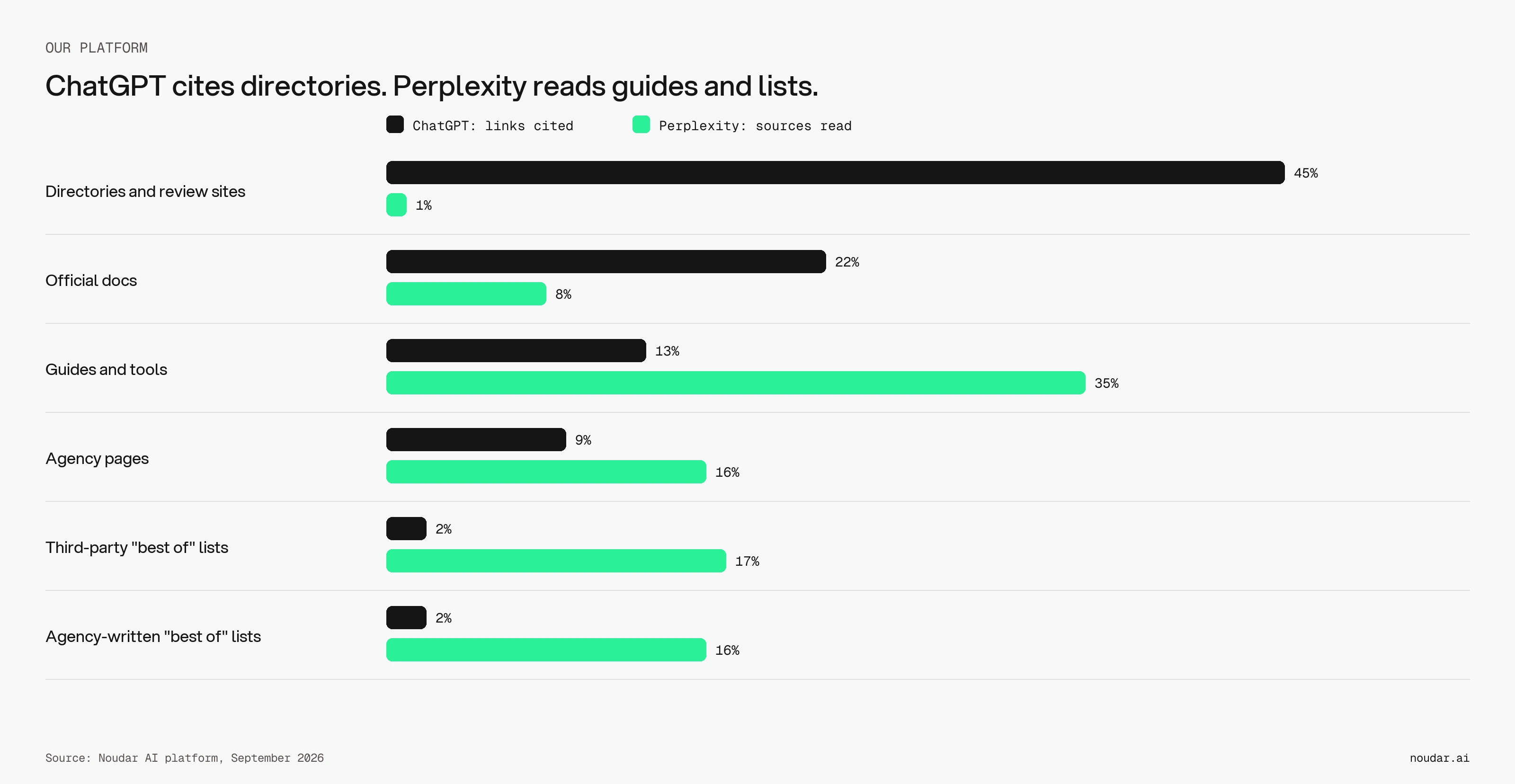
The mix is almost reversed. One page will not win both engines.
The engines also disagree on who to name. Our platform found that only about 1 in 8 of the companies named (12%) showed up in both ChatGPT's and Perplexity's answers. ChatGPT named about 50% more different companies than Perplexity. Names were read from the answers automatically, so expect some noise.
Short answer: it turns one buyer question into a few short search queries. Those queries decide which pages it reads. If your pages do not match them, you are not in the pool.
Here is a real example from our platform. The question was "What's the best AEO agency for a B2B SaaS company?" ChatGPT ran these searches:
Every page it then cited was a Clutch or G2 page. The agencies it named were the ones on those pages. Source: our platform, September 2026.
The same thing happens when people ask ChatGPT how it works. For "How does ChatGPT decide which companies to recommend?", it searched for things like "OpenAI ChatGPT recommendations how model decides which companies to recommend official". Every link it cited was an OpenAI page.
The lesson is simple. The searches are short and literal. They use the category name, the buyer type and words like "best" and "agency". Pages that state those plainly are easier to find.
Short answer: four signals showed up again and again. We label each one as stated (OpenAI says so) or observed (our platform saw it). We do not give weights, because no one can measure them honestly.
| Signal | Stated or observed | What we saw |
|---|---|---|
| Crawler access | Stated | OpenAI says OAI-SearchBot powers ChatGPT search. Block it and your pages cannot be read for search. |
| Directory and review profiles | Observed | 45% of the links ChatGPT cited were directories and review sites like Clutch and G2 (our platform). |
| Inclusion in "best of" lists | Observed | Lists were 33% of the sources Perplexity read (17% third-party, 16% agency-written) (our platform). |
| Clear category pages | Observed | ChatGPT's searches used plain category words. Pages that say "AEO agency for B2B SaaS" match them. |
Note what is missing. Schema and llms.txt are not on this list. They are good hygiene, but we have no evidence they make ChatGPT name you.
Short answer: OpenAI says ads are kept apart from answers. Ads are labelled, and they do not change what ChatGPT recommends. Treat paid and earned as two separate channels.
For a B2B SaaS team, this means buying ads will not get you into the organic answer. The answer still comes from the pages ChatGPT reads.
Short answer: make sure ChatGPT can read you, then get onto the sources it reads. Here are five actions, in order.
We turn AI visibility into pipeline. The first step is knowing where you stand.
Our free AI visibility audit shows how ChatGPT and Perplexity answer your buyers' questions today, with results in 12 hours. We cannot promise any engine will name you. We can show you what is in the way.
Mostly directories and review sites. Our platform found that 45% of the links ChatGPT cited were directories and review sites like Clutch and G2, 22% were official docs and 13% were guides and tools. Perplexity's sources looked different: guides and "best of" lists led. If you sell software, complete, honest directory profiles are the first place to start.
Rarely. Our platform found that only about 1 in 8 of the companies named (12%) showed up in both engines' answers, and ChatGPT named about 50% more different companies than Perplexity. The two engines read different kinds of sources, so they reach different names. Check both engines for your own buyer questions, and plan separate work for each one rather than one page for both.
You can buy an ad, but not a place in the answer. OpenAI says ads are labelled as sponsored, sit apart from the answer and run on separate systems, so advertisers cannot shape, rank or alter responses (OpenAI help). Ads do not show on Plus or Pro plans. To be named in the answer, be on the pages ChatGPT reads.
No, not on its own. OpenAI's crawler docs say GPTBot crawls for training, while OAI-SearchBot powers ChatGPT search. You can block one and allow the other in robots.txt. Changes take about 24 hours to apply. Also check your CDN or firewall, which can block AI crawlers that your robots.txt allows.