/AEO
How to choose an AEO agency in 2026
October 1, 2026
Free AI visibility audit: see what ChatGPT tells your buyers about you →
Get it free
/AEO
October 1, 2026
Pick an AEO agency that starts from your buyers' real questions and shows how it measures AI answers (questions, engines, re-checks). It should tie results to pipeline, publish its price and refuse to promise rankings or citations. Then test it on a 90-day scope with written goals.
Your buyers now ask AI what to buy. In a G2 survey, 51% of B2B software buyers start research in an AI chatbot more often than Google. The same survey found that 69% say a chatbot led them to a different vendor than planned. If your brand is missing from those answers, an AEO agency can help. Picking the wrong one costs you a quarter.
This guide works the same whether you hire us or someone else. It walks through six steps: brief, shortlist, questions, proof, price and a 90-day test.
You need one if buyers in your category ask AI for advice and you have no one in-house to run the work. You do not need one if you lack a clear product and buyer, or if no one on your side can approve content each week.
Signs you should hire:
Signs you should wait:
Write one page before you talk to anyone. A brief makes every agency answer the same question, so you can compare them.
Put these in it:
Look in three places: directories, lists and referrals. Then check each name against your brief.
Each AI engine leans on different sources. From our platform, in September 2026, 45% of the links ChatGPT cited were directories and review sites like Clutch and G2. Of the sources Perplexity read, 16% were agency-written "best of" lists. So the names AI gives you depend on which engine you ask.
Read agency lists with care. On 1 October 2026 we read five "best AEO agency" lists written by agencies. All five ranked their own author first: NoGood, First Page Sage, Optimist, Omnius and Unified Platforms. That does not make them wrong. It means you should judge each name on its own facts.
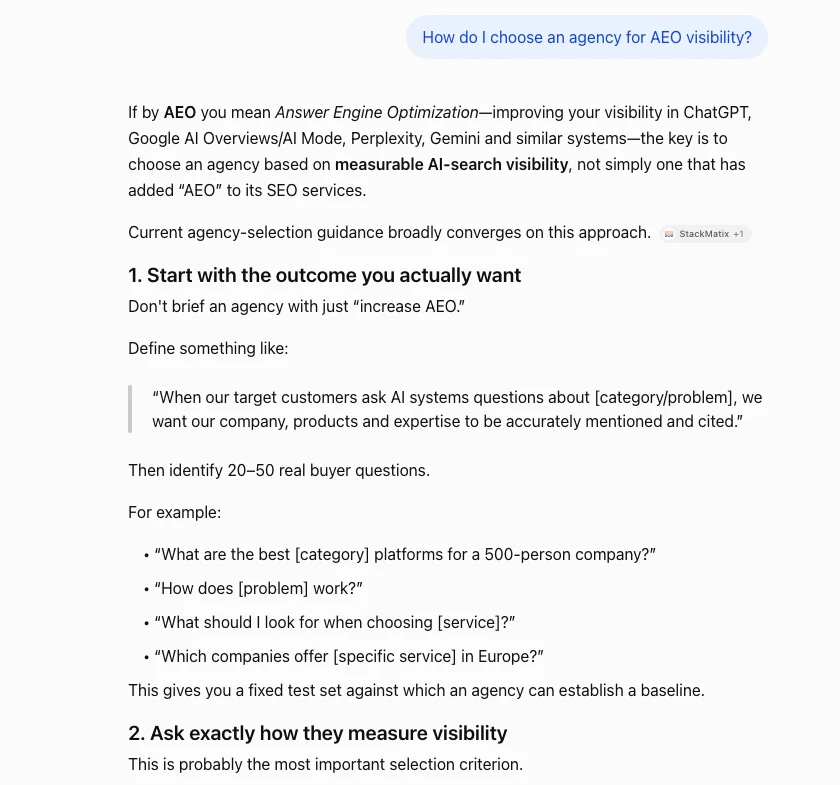
Ask every agency the same 10 questions. The answers tell you more than any deck. Here is what a good answer and a red flag sound like.
| # | Question | Good answer | Red flag |
|---|---|---|---|
| 1 | Which buyer questions will you track, and how did you pick them? | A written list built from your sales calls, reviews and search data. You get a copy. | "We track thousands of keywords." No list. |
| 2 | Which AI engines, and how many runs per prompt? | Names each engine and repeats each prompt, because answers change from one ask to the next. | One screenshot as proof. |
| 3 | How will you tie this to pipeline? | An AI channel in your analytics, a "how did you hear about us" field and a CRM check. | A visibility score and nothing else. |
| 4 | What ships in the first 30 days? | Named pages, fixes and reports, with dates. | A long "strategy phase" with no output. |
| 5 | Who does the work, and where do you use AI? | Clear roles. Says what AI drafts and who checks it. | Cannot say who reviews the work. |
| 6 | What will you not do? | Names its limits and the clients it turns away. | "We do everything." |
| 7 | How do you handle Reddit and communities? | Disclosed accounts only, inside each community's rules. | Posting from fake or undisclosed accounts. |
| 8 | What do you think of schema and llms.txt? | Hygiene worth doing, not the thing that gets you cited. | Sells either one as the main AI fix. |
| 9 | Can I see a case study with a baseline, a time window and the method? | Yes, and it shows how the result was measured. | A big percentage with no start point or dates. |
| 10 | What are the exit terms? | A clear notice period. You keep all the work. | A long lock-in with no way out. |
On question 8, Google says no extra requirements or special optimisations are needed to appear in AI Overviews and AI Mode. And llms.txt is still a proposal by Jeremy Howard (2024), not a standard the engines have said they use.
Ask for three things behind every result: the baseline, the time window and how it was measured. A number without those is a claim, not proof.
In our read of 52 published agency case studies, about 10 of the 47 real engagements report leads, signups or revenue. Most report traffic or visibility.
Watch for the same result told two ways. One Discovered Labs case is quoted on Optimist's list as 4x, from 550 to 2,300+ AI-referred trials. On HubSpot's case-study roundup it reads 6x, from 575 to 3,500+ (both as of 1 Oct 2026). Ask the agency for the primary source.
Be careful with AI screenshots too. Answers change from one ask to the next and between engines. Our platform found that only about 1 in 8 of the companies named (12%) appeared in both ChatGPT's and Perplexity's answers. One screenshot shows one answer on one engine. Ask which questions and engines sit behind it, and how often each was re-checked.
Published AEO and GEO agency retainers run from about USD 3,000 to over USD 15,000 a month, as of 1 October 2026. Many agencies publish no price at all.
A few published examples, checked 1 October 2026:
Put these in the contract:
Agree written goals at kickoff, then review at day 30, 60 and 90. A fixed test shows how the agency works before you commit to a long retainer.
Split goals into two kinds. Goals the agency controls: pages shipped, fixes done, prompts tracked, AI channel set up in analytics. Goals it can only influence: being named in AI answers, demos and pipeline. Judge the first kind hard. Track the second kind honestly, over time.
Expect early signs, not full results. Agencies state their own timelines: Discovered Labs says first results in 1 to 2 weeks and full impact in 3 to 4 months. Optimist says results in 1 to 3 months, compounding over 6 to 12.
Walk away from any of these:
We turn AI visibility into pipeline. Noudar AI is an AI-native SEO and AEO agency for B2B SaaS and tech companies, based in Portugal. AI does the research, checks and first drafts. SEO and AEO experts make every call.
We are new and have no client case studies yet. So we run a Design-Partner batch: 3 spots, open until 31 October 2026. It costs EUR 1,500 at the start and EUR 1,500 at day 90. If we miss the goals agreed at kickoff, you get a full refund. A case study with us is part of the deal.
Ask us the 10 questions above. Hold us to the same answers.
Get a free AI visibility audit, results in 12 hours. Or see pricing.
Three or four is usually enough. Send each the same one-page brief and ask the same 10 questions, so the answers are easy to compare.
Agencies state different timelines. Discovered Labs says first results in 1 to 2 weeks, full impact in 3 to 4 months. Optimist says 1 to 3 months, compounding over 6 to 12. Treat any timeline as a target, not a promise.
An SEO agency works to rank your pages in Google. An AEO agency works to get your brand named and cited in AI answers. The two overlap: our platform found that 72% of Google top-10 URLs for our keywords came from a domain AI also used. Most B2B SaaS teams need both.
A tool tells you where you show up. It does not write pages, fix your site or earn mentions. If you have a team to do that work, a tool may be enough. If not, you need people.