/AEO
What is AEO (answer engine optimization)?
October 1, 2026
Free AI visibility audit: see what ChatGPT tells your buyers about you →
Get it free
/AEO
October 1, 2026

Answer engine optimization (AEO) is the work of getting your company named and cited when people ask AI tools like ChatGPT, Perplexity or Google AI Overviews a question. It builds on SEO: AI engines search the web, read pages and quote sources, so being findable and quotable is the core of it.
Your buyers already ask these tools what to buy. 51% of B2B software buyers start research in an AI chatbot more often than Google. Gartner found that 9% of buyers discover software with GenAI tools vs 8% via search engines. If the answer names three rivals and not you, you may never hear about that lost deal.
This guide shows how an AI answer gets built and what AEO is not. Then it gives a short test for whether your SaaS needs it, one real answer from our platform, and a plan for your first 30 days.
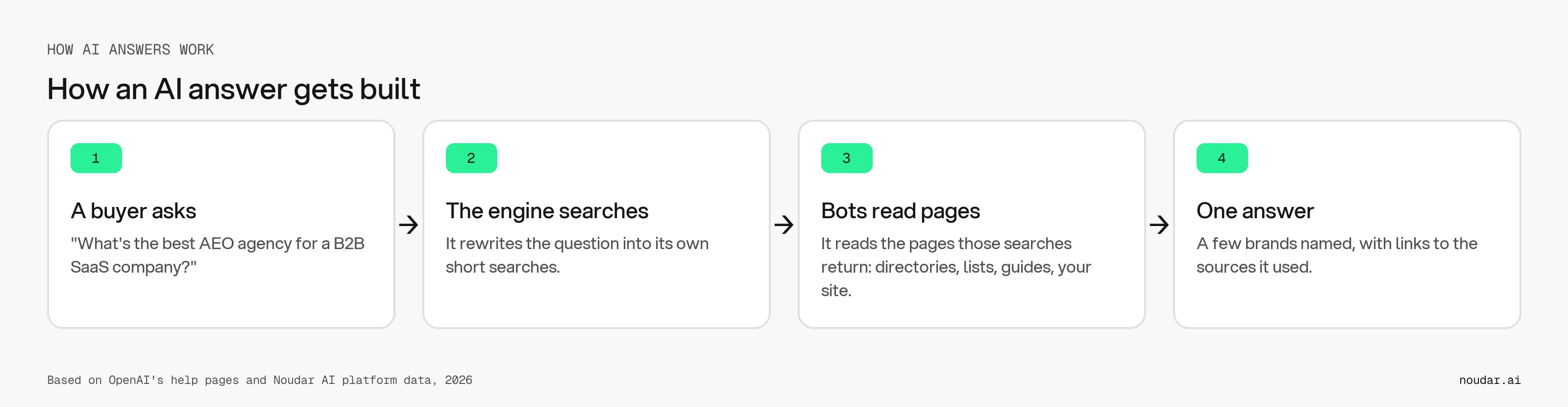
In three steps: the engine searches, reads, then writes one answer with sources. If your pages are not found or not readable, you cannot be quoted.
1. Search. The engine turns the question into its own web searches. From our platform: when asked "What's the best AEO agency for a B2B SaaS company?", one engine searched for "best AEO agency B2B SaaS 2026 answer engine optimization" and similar phrases.
2. Read. The engine's bots fetch the pages it found. Each AI company runs named bots, and you control them in robots.txt:
| Company | Bots | What they do |
|---|---|---|
| OpenAI | OAI-SearchBot, GPTBot, ChatGPT-User | ChatGPT search, training, and fetches a user asks for. Robots.txt changes take about 24h |
| Perplexity | PerplexityBot, Perplexity-User | Search (not training), and fetches a user asks for |
| Anthropic | ClaudeBot, Claude-User, Claude-SearchBot | Each bot can be blocked on its own in robots.txt |
3. Write and cite. The engine writes one answer and links some of the sources it read. OpenAI explains how this works in its help article on searching the web with ChatGPT.
Think of the answer as the new shelf. Buyers used to scan ten links. Now they read one answer, and only a few companies make it onto that shelf.
AEO is not a trick. It is not a file, a tag or a batch of fake posts.
Probably, if your buyers research before they talk to sales. Answer these five questions about your company.
| # | Question | Why it matters |
|---|---|---|
| 1 | Do your buyers research online before a demo? | If yes, AI answers shape the shortlist before you meet them |
| 2 | Does your category have "best X" or "X vs Y" questions? | These are the questions where AI answers name vendors |
| 3 | Is your deal size large enough that one lost deal hurts? | Then a missing mention costs real money |
| 4 | When you ask ChatGPT or Perplexity about your category, are rivals named? | If rivals are named and you are not, buyers see them first |
| 5 | Is your own name missing from those answers today? | That gap is what AEO work closes |
The more yeses, the sooner AEO pays its way. If you answered no to the first two, put your money into sales and product first.
To check question 5, ask your category questions in ChatGPT and Perplexity. Ask each one a few times, since answers change from one ask to the next. Note who is named and which sources are linked.
Here is one buyer question from our platform, asked in September 2026: "What's the best AEO agency for a B2B SaaS company?" We asked it on ChatGPT and on Perplexity, with web search on (method).
ChatGPT. It named five agencies: XEO.works, Takeoff Agency, Trivero Marketing, LLM Listed and Angelfish Marketing. ChatGPT cited only Clutch and G2 profile pages, and it did the same each time we asked again.
Perplexity. It named Omniscient Digital first, then First Page Sage, RevenueZen, NoGood, Quoleady and Embarque. Most of the sources it read were "best AEO agencies" lists, many of them on agency sites. The rest were LinkedIn posts, a media article and a guide. The answer itself warned that many agency rankings are written by the agencies themselves.
What the two answers had in common. Nothing. No agency appeared in both answers. Perplexity named Omniscient Digital each time we asked, and ChatGPT never did (our platform).
The lesson for any SaaS company: each engine built its answer from a different shelf. ChatGPT cited directory profiles. Perplexity's sources were mostly "best of" lists. To be named on both, you need to be on both shelves. We go deeper in how ChatGPT decides which companies to recommend.
Check where you stand, open the door to AI bots, fix your key pages, and start earning mentions. This checklist assumes a small team.
| Week | Task | Owner |
|---|---|---|
| 1 | Write down the buyer questions that come before a demo. Ask sales what prospects ask | Marketing lead with sales |
| 1 | Ask those questions in ChatGPT and Perplexity a few times each. Log who is named and which sources are linked | Marketing lead |
| 1 | Check robots.txt allows search bots such as OAI-SearchBot and PerplexityBot | Web or dev |
| 2 | Submit key pages to Bing with IndexNow. It does not promise a crawl, but it speeds discovery | Web or dev |
| 2 | Rewrite your pricing, comparison and use-case pages answer-first: who it is for, what it costs, what proof you have | Marketing lead |
| 3 | Create or complete your Clutch or G2 profile. Ask real clients for reviews | CEO or sales lead |
| 3 | List the third-party "best X" pages that show up in the answers and their sources. Pitch the authors honest proof | Marketing lead |
| 4 | Set up a GA4 custom channel group for AI assistants and add "How did you hear about us?" to your demo form | RevOps |
| 4 | Ask the same questions again. Compare with week 1 | Marketing lead |
Do not expect a big change in 30 days. The first month sets your baseline and fixes what blocks you.
Count how often AI answers name you for your buyer questions, then follow those buyers into your pipeline. Report each number with the questions behind it.
Answers change from one ask to the next, so one check proves little. Track the same questions on a fixed schedule.
They overlap far more than they differ. SEO is about ranking pages in search engines. AEO is about being named and cited in AI answers. GEO (generative engine optimization) is a near-synonym for AEO, used more by some teams.
The term GEO comes from a research paper. GEO: Generative Engine Optimization (Aggarwal et al.) reports visibility gains of up to 40% in generative engine responses. That was a lab study, not a live market test.
We turn AI visibility into pipeline. Our free AI visibility audit asks your buyer questions in AI tools. We re-check every question, because AI answers change from one ask to the next. It shows the answers, who is named instead of you, the sources behind them and your top 3 blockers. Results in 12 hours.
Get your free AI visibility audit
Want a team to do the work? Our Design-Partner batch 1 has 3 spots, open until 31 Oct 2026. You pay EUR 1,500 at the start and EUR 1,500 at day 90. If we miss the goals agreed at kickoff, you get a full refund. A case study with us is part of the deal. See pricing
AEO stands for answer engine optimization. An answer engine is an AI tool that replies with one written answer instead of a list of links, such as ChatGPT, Perplexity or Google AI Overviews. In marketing, AEO is the work of getting your company named and cited in those answers when buyers ask what to buy.
Mainly ChatGPT, Perplexity and Google AI Overviews, plus tools like Claude. Each engine builds answers from different sources, so treat them apart. For one buyer question on our platform, ChatGPT cited only Clutch and G2 profile pages, while Perplexity's sources were mostly "best of" lists. One page will not win every engine.
No. Google says no extra requirements or special optimisations are needed to appear in AI Overviews and AI Mode. llms.txt is a proposal by Jeremy Howard (2024), and no one has shown it gets you cited. Keep schema valid as normal SEO hygiene, and put your effort into clear pages and real mentions.
No. AI answers name many small companies, not only market leaders. Our platform found that two thirds of the companies ChatGPT named appeared only once. Engines pick from the pages they read, so a small company that sits on the right lists, directories and review sites can be named. Being in the sources matters more than size.
Usually the marketing lead, with help from sales, web and RevOps. Sales shares the questions prospects ask before a demo. A web developer checks that AI search bots can reach your pages. RevOps sets up an AI channel in GA4 and a "how did you hear about us?" field. The CEO or a sales lead asks real clients for reviews.