/AI search
Why ChatGPT recommends your competitors and not your SaaS
October 1, 2026
Free AI visibility audit: see what ChatGPT tells your buyers about you →
Get it free
/AI search
October 1, 2026
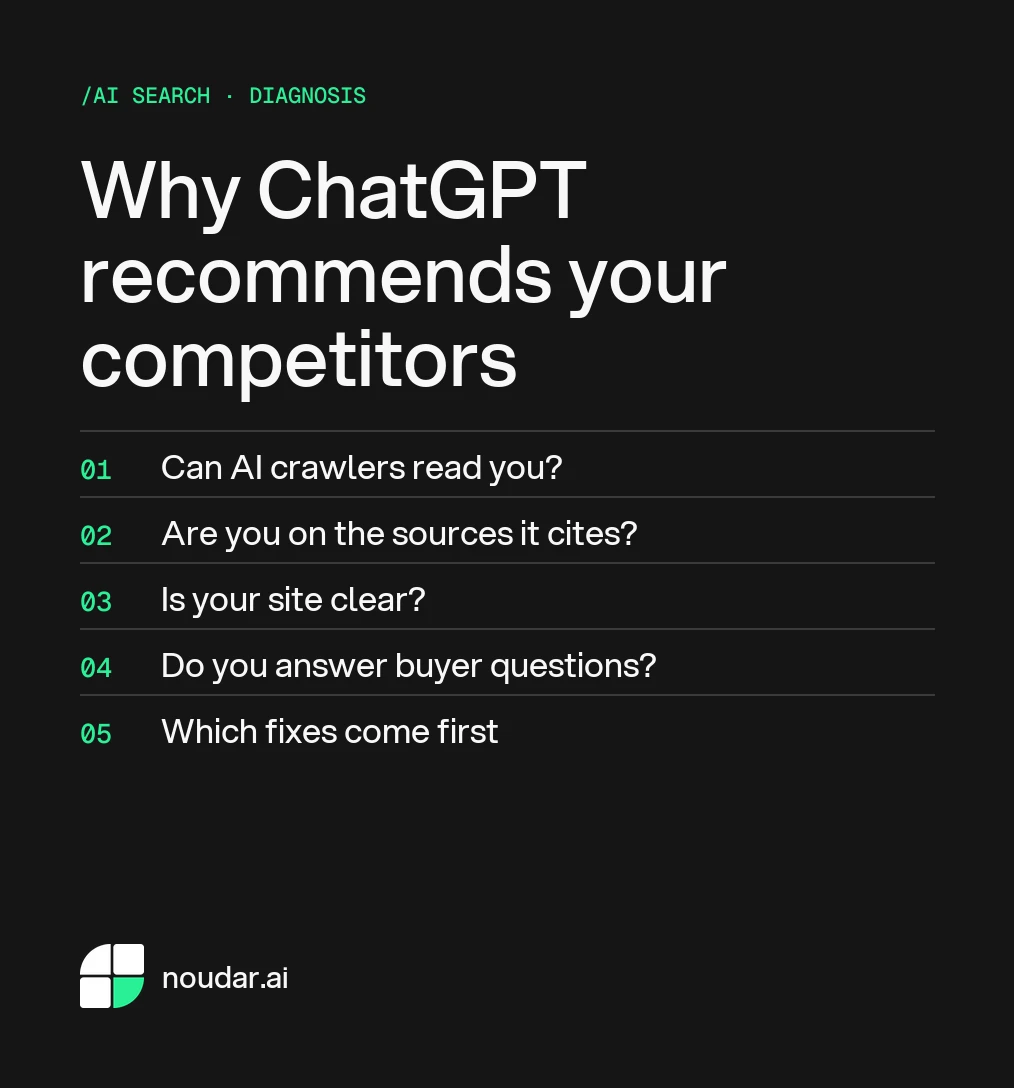
ChatGPT names the companies that the pages it reads already mention: directories, review sites, "best of" lists and clear category pages. If your competitors are on those sources and you are not, or if AI crawlers can't read your site, you get left out. The fix starts with access, then mentions, then pages.
This matters because buyers act on these answers. In G2's 2026 survey, 69% of B2B software buyers said a chatbot led them to a different vendor than planned. If that vendor is your competitor, you can lose the deal without ever seeing it.
Below is a 4-step check in the order we run it. Each step rules out one cause before you spend money on the next.
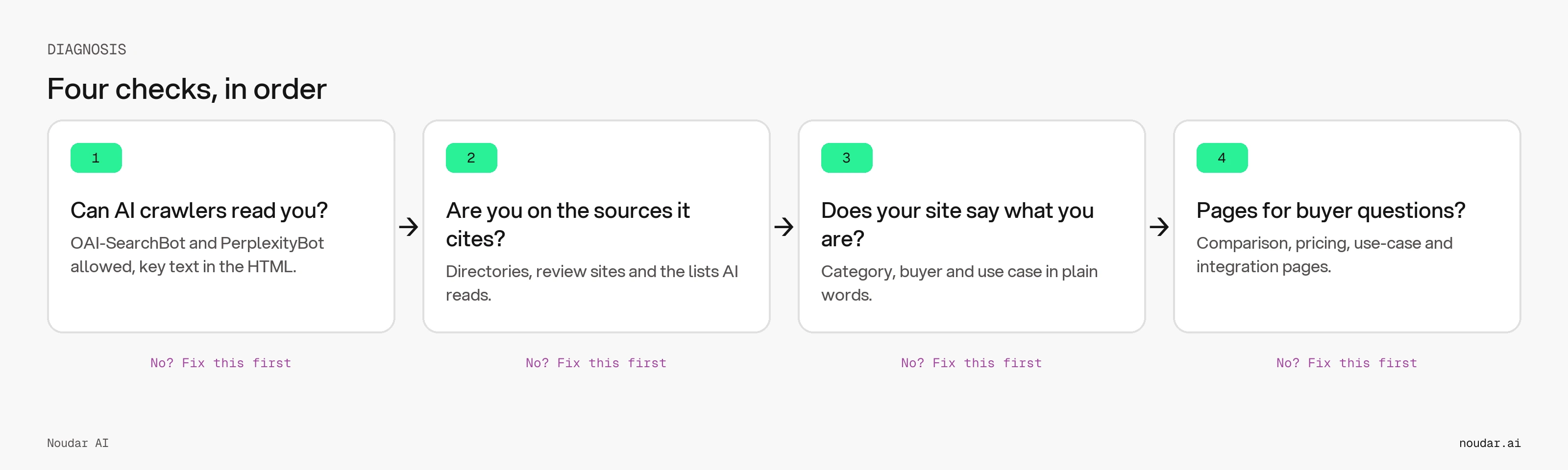
Short answer: if you block the bots, nothing else matters. Check this first. It is the cheapest fix and the fastest to take effect.
Each AI engine uses its own crawlers. OpenAI's docs say OAI-SearchBot powers ChatGPT search, GPTBot crawls for training and ChatGPT-User fetches pages when a user asks. Changes to robots.txt take about 24 hours to apply. Perplexity's docs say PerplexityBot crawls for search, not training, and Perplexity-User fetches pages for users.
What to check:
Short answer: ChatGPT leans heavily on directories and review sites. If your competitors have Clutch or G2 profiles and you do not, that alone can explain the gap.
Our platform tested this in September 2026. It asked ChatGPT and Perplexity the questions B2B buyers ask, with web search on, and sorted every source by type: the links ChatGPT cited in its answers, and the sources Perplexity read.
| Source type | ChatGPT (links cited) | Perplexity (sources read) |
|---|---|---|
| Directories and review sites (Clutch, G2) | 45% | 1% |
| Official docs | 22% | 8% |
| Guides and tools | 13% | 35% |
| Agency pages | 9% | 16% |
| Third-party lists | 2% | 17% |
| Agency-written "best of" lists | 2% | 16% |
Source: our platform, September 2026.
So the two engines need different work. For ChatGPT, directory and review profiles come first. For Perplexity, getting onto "best of" lists and useful guides matters more. We explain the source mix in more detail in how ChatGPT decides which companies to recommend.
Short answer: ChatGPT matches short, literal searches. If your homepage says "the future of work" instead of "HR software for remote teams", it is hard to match.
From our platform, ChatGPT turned each buyer question into a few plain searches. They used the category name, the buyer type and words like "best". Pages that say those words in plain text match them. Pages built on slogans do not.
What to check:
Short answer: buyers ask narrow questions. "Best CRM for a small agency." "Does X integrate with HubSpot?" If you have no page that answers them, ChatGPT has nothing of yours to read.
The pages that help most:
Short answer: not in our platform's data. ChatGPT named whoever was listed on the sources it read. Being on those sources looked more important than being big.
Our platform found that two thirds of the companies ChatGPT named appeared only once. Only about 1 in 8 (12%) showed up in both ChatGPT's and Perplexity's answers. That is a wide spread, not a small club of big names. Names were read from the answers automatically, so expect some noise.
The question below shows why. Every agency ChatGPT named had a Clutch or G2 page it could read. The one agency Perplexity named every time did not appear in any of ChatGPT's answers to that question. New names can get in. The route is the sources, not the size.
Short answer: for one buyer question, every source ChatGPT cited was a Clutch or G2 page. The agencies it named were the ones on those pages.
The question: "What's the best AEO agency for a B2B SaaS company?" Source: our platform, September 2026.
Across ChatGPT's answers to this question, it named XEO.works, Takeoff Agency, Trivero Marketing, LLM Listed, Angelfish Marketing, Stellar AEO Labs, Broworks, Victorious, Salienz and AIclicks. Every source it cited was a Clutch profile, a Clutch category page or a G2 page.
What we learned:
On Perplexity, most of the sources behind the same question were "best of" lists, and most of those sat on agency sites. Same question, different sources, different winners.
Short answer: start with the cheap, fast fixes. Access first, then profiles, then pages, then lists. The table ranks them by cost and time, based on our judgement.
| Fix | Cost | Time to take effect | Helps most on |
|---|---|---|---|
| Allow OAI-SearchBot and PerplexityBot | Very low | About 24 hours for OpenAI's robots.txt (OpenAI) | Both |
| Clear category words on homepage and profiles | Low | Next crawl (no published timing) | Both |
| Clutch and G2 profiles with real client reviews | Low to medium | Depends on reviews | ChatGPT |
| Use-case, comparison and pricing pages | Medium | Weeks to months (our estimate) | Both |
| Getting onto cited "best of" lists | Medium to high | Months (our estimate) | Perplexity |
Two rules on the fixes. Reviews must come from real clients. Any community or list outreach must be disclosed.
Short answer: we ran this check on ourselves. Our platform found that Noudar AI did not appear in any AI answer about agencies. That is our starting point.
We are a new agency, so we started with few of the sources above in place. The steps above are our own plan. We will report what changes, good or bad, as our first case study. We cannot promise ChatGPT will name us, and we will not promise it will name you.
We turn AI visibility into pipeline. The first step is finding what is in the way.
Our free AI visibility audit asks your buyers' questions on ChatGPT and Perplexity. We re-check every question, because AI answers change from one ask to the next. It shows who ChatGPT and Perplexity name instead of you, the sources behind them and your top 3 blockers. Results in 12 hours. New to AEO?
Not in our platform's data. ChatGPT named the brands listed on the pages it read, big or small. Our platform found that two thirds of the companies ChatGPT named appeared only once. In our teardown question, every agency it named had a Clutch or G2 page it could read. A new company gets in by being on those sources, not by being bigger.
Not always, but it is the most common source ChatGPT cited. Our platform found that 45% of the links it cited were directories and review sites, and for one buyer question every cited page was a Clutch or G2 page. Set up both with your category, your buyer type and reviews from real clients. Never invent reviews.
It depends on the fix. Robots.txt changes take about 24 hours to apply, according to OpenAI. New wording on your homepage is picked up on the next crawl, and no one publishes a timing for that. New pages and list placements take weeks to months, by our estimate. Recheck your buyer questions after each fix, several times each.
Turn on search, ask your buyer question and open the sources listed with the answer. Note each page that names your competitor, and check whether you appear on it. Ask the same question a few times, because the names change from one ask to the next. The pages that keep coming up are your list of profiles to claim and publishers to contact.