/AEO
How long does AEO take? A realistic 90-day timeline
October 5, 2026
Free AI visibility audit: see what ChatGPT tells your buyers about you →
Get it free
/AEO
October 5, 2026
Technical fixes and first pages ship in weeks 1 to 4. Changes in AI answers can show within weeks, but they swing from one ask to the next, so read them as ranges after about a month of data. Pipeline from AI search usually takes longer: plan on leading signs at 30, 60 and 90 days.
Technical fixes and first pages ship in weeks 1 to 4. Changes in AI answers can show within weeks, but they swing from one ask to the next, so read them as ranges after about a month of data. Pipeline from AI search usually takes longer: plan on leading signs at 30, 60 and 90 days.
Ask five pages how long AEO takes and you get five answers. Some say weeks. Some say six months. This guide explains why, then lays out what a B2B SaaS team can expect to see, week by week, in the first 90 days.
The question matters because buyers have moved. 51% of B2B software buyers now start research in an AI chatbot more often than Google, says G2. You want to know when that shift starts to show up in your pipeline.
They disagree because they measure different things. A crawler fix shows in days. A change in AI answers shows in weeks, but noisily. Pipeline shows in months. Most pages put all three under one word, "results".
Here is what the most-read pages on this question say, as read on 5 October 2026:
| Page | What it times | What it says |
|---|---|---|
| Progression | Technical and content steps | Crawler hits in about 2 days, render fixes in about 2 weeks, passage changes in 3 to 6 weeks. Citation frequency does not read honestly until about month six |
| HubSpot | Program phases | Month 1 setup, weeks 6 to 8 early gains, months 3 to 6 momentum, months 6 to 12 business impact |
| GreenBanana | Citations | Citations visible in 60 to 90 days, sustained results in 3 to 6 months |
| Stackmatix | Citation rate | First signals at days 30 to 45, with citation-rate targets by month. No method is given for the targets |
Line them up by metric and they stop fighting. Fixes are fast. AI answers move early but need time to read. Business impact comes last. So the honest answer to "how long" is a question back: "how long until what?"
Three things make your own timeline longer or shorter:
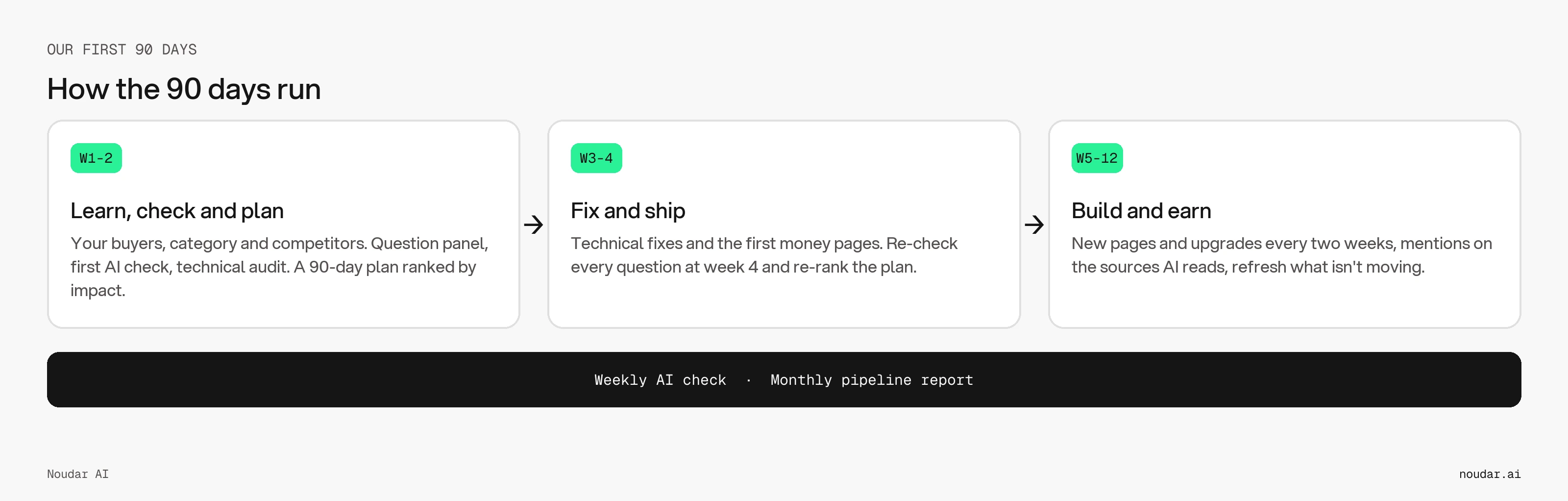
Each block ships work you can check, and each one adds a signal you can read. The table below is our 90-day plan. The last column matters most: it tells you what not to judge yet.
| Weeks | What ships | What you can read | What you can't read yet |
|---|---|---|---|
| 1 to 2: Plan | We learn your business and map the questions buyers ask. First AI check and technical audit. A 90-day plan ranked by impact | Your starting point: where AI names you, who it names instead, the sources it uses, what blocks bots | Any trend. One snapshot is a baseline, not a result |
| 3 to 4: Fix | Technical fixes. First money pages. Profile updates. First pitches to the lists AI reads | Fixes confirmed live. New pages indexed. Early impressions in Google Search Console | Whether AI answers changed for good. Single readings swing too much |
| 5 to 8: Build | New pages every two weeks. Mentions on the sites AI looks at. We re-check every question | AI answers as ranges across weeks. Which questions moved, which didn't. First AI visits in analytics | Pipeline. Most deals touched now have not closed |
| 9 to 12: Scale | More of what moved. Refresh what didn't | Trends across a month or more. Leading pipeline signs: demos that mention AI, branded searches | Full revenue from AI search, if your sales cycle runs longer than the program |
| Day 90 | Review against the goals agreed at kickoff | Leading signs at 30, 60 and 90 days, side by side |
Why wait a month before reading AI answers? Because they change a lot. From our platform, two thirds of the companies ChatGPT named appeared only once. That is why we re-check every question, because AI answers change from one ask to the next. One good day is not a result.
At week 4, we re-check every question and re-rank the plan. Early work focuses on safe bets: fixes and clear buying-stage pages. Bigger bets wait until the data has settled.
Most published AEO and SEO case studies report their headline result after 4 to 12 months. Few report one inside 3 months, and those mostly measure AI answers or pages shipped, not revenue. All results below are the agencies' own claims.
We read 52 published case studies from four agencies. 47 were real client engagements, and 26 of those were SEO or AEO work. For each of the 26, we noted the time window the agency gave for its headline result:
| Time window for the headline result | Cases |
|---|---|
| Under 3 months | 3 |
| About 3 months | 3 |
| 4 to 6 months | 9 |
| 7 to 12 months | 8 |
| Over 12 months | 3 |
| Total | 26 |
Source: Noudar's own read of 52 published agency case studies, 1 October 2026. Results are self-reported. Windows are as each case states them, and some are approximate.
Three patterns stand out:
So treat any timeline claim, ours included, with the same test. Ask what was measured, from what baseline, over what window.
Pipeline shows up after AI answers change and buyers act on them. How long that takes depends on your sales cycle. You will miss it unless tracking is in place before the work starts.
Set up three things in week 1:
The sales call matters more than it looks. 69% of B2B buyers prefer to validate AI-generated insights with sales reps, says Gartner. Buyers who found you in AI often say so on the call.
What to look for at each checkpoint:
Diagnose from the top down before you decide. Most stalls sit at one step, and fixing a lower step while a higher one is broken wastes time. Then decide to continue, change scope or stop.
Check in this order:
Continue when the work shipped and leading signs moved on buying questions, even if revenue hasn't closed yet. Change scope when one step is stuck, for example AI names you but visitors don't convert. Stop or pause when the work didn't ship, or nothing moved after fixes were live and confirmed.
Whatever you decide, keep the baseline and the reports. They make the next decision faster.
We turn AI visibility into pipeline. Our Design-Partner Program runs 90 days, end to end: strategy, content, technical fixes, mentions, weekly AI checks and a monthly pipeline report. AI does the research, checks, first drafts and tracking. SEO and AEO experts make every call.
It costs EUR 3,000: EUR 1,500 at the start and EUR 1,500 at day 90. We agree the goals at kickoff. If we miss them, you get a full refund and keep the work. We have no client case studies yet, so a case study with us is part of the deal. Batch 1 has 3 spots, open until 31 October 2026.
After day 90, you decide whether to continue. If you do, we agree the next scope and price together.
See pricing. To compare what other agencies charge, read how much an AEO agency costs.
Expect shipped work and leading signs, not finished revenue. By day 90 you should see fixes live, new pages indexed, AI answers moving as a range on some buying questions, and first AI visits. Demos that mention AI can appear too. Closed revenue depends on your sales cycle. Our free AI visibility audit shows your starting point first.
Because AI answers change from one ask to the next. From our platform, two thirds of the companies ChatGPT named appeared only once. So one check proves little. Re-check the same questions over several weeks and read the result as a range. Judge the trend across a month, not a single day.
Use three sources together. Add an AI channel in Google Analytics with custom channel groups. Add a "How did you hear about us?" field with ChatGPT and Perplexity as options. Ask on sales calls where the buyer first heard of you. Analytics undercounts AI visits, so the form and the call often carry the proof.
Stop or pause when the agreed work did not ship, or when nothing moved after fixes were live and confirmed. Before you decide, check each step from the top: can bots read the site, are pages indexed, does AI name you, do visitors convert. If one step is stuck, change the scope instead. See our pricing for how our day 90 review works.