/AEO
AEO vs GEO: which should a B2B team focus on?
October 5, 2026
Free AI visibility audit: see what ChatGPT tells your buyers about you →
Get it free
/AEO
October 5, 2026

For a B2B team, AEO and GEO are two names for nearly the same work: getting named in AI answers. Focus on the buyer questions that lead to demos, make your pages quotable and get onto the sources engines cite. The label matters far less than the questions you choose.
For a B2B team, AEO and GEO are two names for nearly the same work: getting named in AI answers. Focus on the buyer questions that lead to demos, make your pages quotable and get onto the sources engines cite. The label matters far less than the questions you choose.
So this is not a choice between two programmes. It is one programme with two names. This guide shows where the terms came from, the few tasks that really differ, and what to fund first if you are a SaaS or tech company between 1M and 10M ARR. New to the topic? Start with what AEO is.
Short answer: GEO comes from a 2023 research paper. AEO came out of the SEO world, from the work of winning Google's answer boxes. Both now describe the same goal.
GEO stands for generative engine optimization. The term comes from a 2023 paper by Aggarwal et al., later presented at KDD 2024. It tested ways to make content show up more in AI-written answers and reports visibility gains of up to 40% in generative engine responses. That was a lab study on test engines, not a result with live buyers. Read it as a signal, not a promise.
AEO stands for answer engine optimization. The idea was the same then as now: be the answer, not just a blue link.
Today, agencies, tools and analysts use both words for the same job. Some add "AI SEO" or "LLMO" too. There is no settled taxonomy, so compare what each team will do, not what it calls it.
Short answer: almost all the work is shared. The real differences are in where you look and which engine you favour, not in the tasks.
When people draw a line between the two, it usually runs like this: AEO leans toward Google's answer features and short, direct answers. GEO leans toward chat engines such as ChatGPT and Perplexity that write longer answers from many sources. In practice, a B2B buyer uses both, so you need both.
This table lists the tasks side by side.
| Task | Shared or different? | What it means for a B2B team |
|---|---|---|
| Build a list of buyer questions ("best X for Y", "X vs Y", "X pricing") | Shared | The list drives everything else. Start from sales calls, not only keywords |
| Answer each question plainly in the first lines of a page | Shared | Pricing, comparison and use-case pages first |
| Let search bots reach your site | Shared | Allow OAI-SearchBot and PerplexityBot, keep content in the HTML |
| Earn mentions on lists, directories and review sites | Shared, but the sites differ by engine | Find which sources each engine reads for your category |
| Classic SEO: indexing, rankings, links | Shared | Google's AI features run on the same base |
| Schema and llms.txt | Shared, and hygiene only | Keep them valid. Do not pay for them as an AI fix |
| Main target surface | Different in emphasis | AEO talk leans to Google AI Overviews, GEO talk to chat engines |
| Tracking | Shared method, split by engine | Track each engine apart, with the questions behind each number |
Six of the eight rows are the same work. The two that differ are about emphasis, and a B2B buyer moves between Google and chat tools anyway. If an agency sells AEO and GEO as two separate services, ask what tasks are in one and not the other. For how AEO relates to classic SEO, read AEO vs SEO.
Short answer: Google says you need nothing special for its AI features. No extra files, no special markup.
Google's AI features doc says no extra requirements or special optimisations are needed to appear in AI Overviews and AI Mode. A page must be indexed and allowed to show a snippet.
Its AI optimization guide goes further. Google says optimising for generative AI search is still SEO. It says no special schema, AI text files (llms.txt), Markdown or content chunking is needed.
That matters for the AEO vs GEO debate. Many pages on this topic sell schema or llms.txt as the thing that makes one label different from the other. For Google, it is not. Schema stays useful as part of normal SEO. llms.txt is a proposal by Jeremy Howard (2024), not a standard the main engines have said they use. Both are hygiene, not levers.
Google speaks only for Google. ChatGPT and Perplexity do not publish the same kind of guide. That is where the next section comes in.
Short answer: each engine leans on different sources. That is the one difference that should change your plan, and it has nothing to do with the acronym.
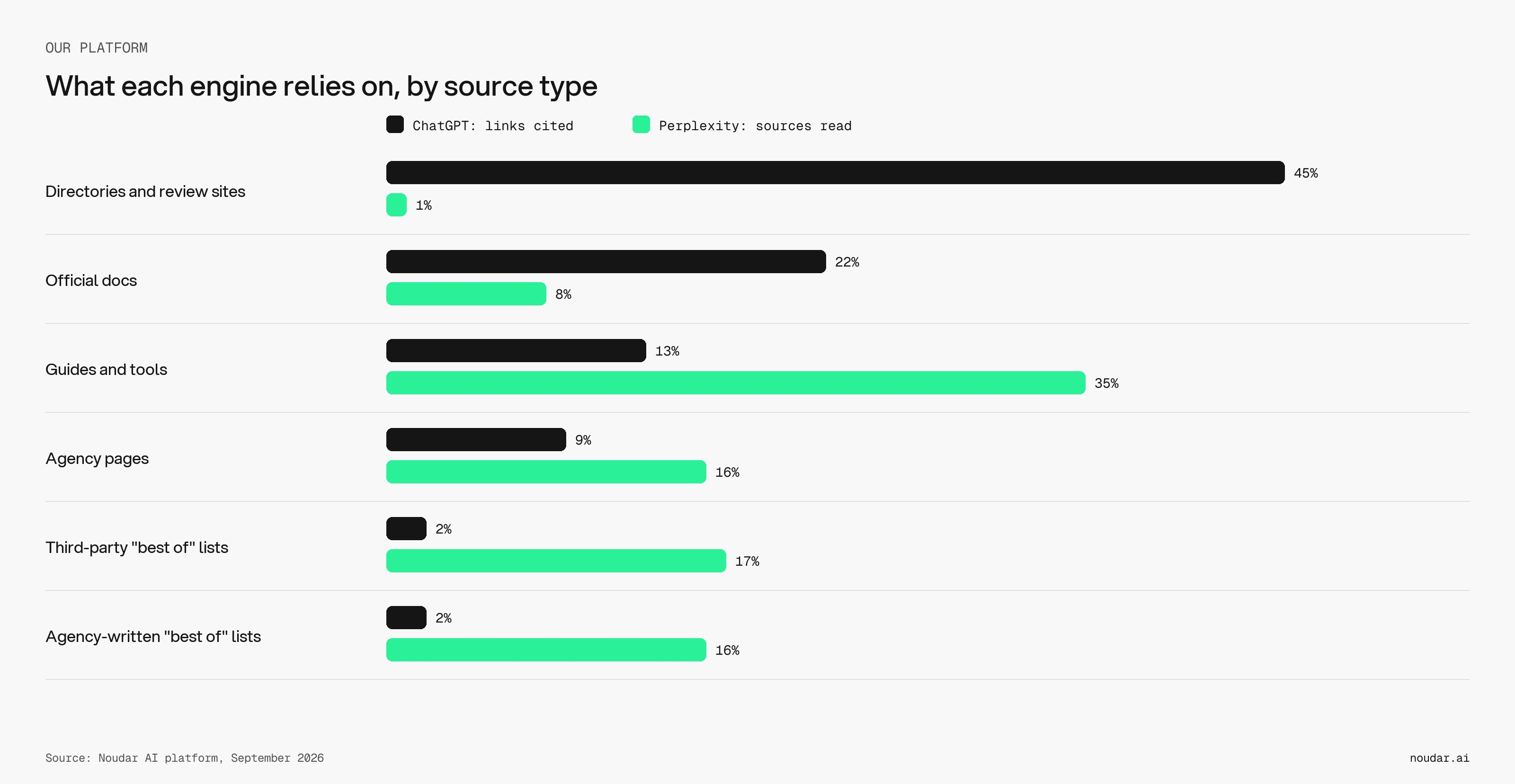
From our platform, ChatGPT and Perplexity read very different kinds of pages for the same buyer questions (September 2026).
| Source type | ChatGPT (share of links cited) | Perplexity (share of sources read) |
|---|---|---|
| Directories and review sites (Clutch, G2) | 45% | 1% |
| Official docs | 22% | 8% |
| Guides and tools | 13% | 35% |
| Agency pages | 9% | 16% |
| Third-party "best of" lists | 2% | 17% |
| Agency-written "best of" lists | 2% | 16% |
Source: our platform, September 2026. For ChatGPT, shares of the links it cited. For Perplexity, shares of the sources it read, so do not compare the two columns as volumes.
The engines also disagree on who to name. From our platform, only about 1 in 8 of the companies named (12%) appeared in both ChatGPT's and Perplexity's answers.
So the useful split is not AEO vs GEO. It is engine by engine. To show up in ChatGPT, a complete, honest profile on the directories in your category matters. To show up in Perplexity, the guides and "best of" lists in your category matter. One page will not win both.
Short answer: fund the buyer questions closest to a demo, then the pages that answer them, then mentions on the sources each engine reads. Skip the label debate.
A team this size has little time and no room for two programmes. Put effort in this order.
| Your situation | Where to start |
|---|---|
| Weak technical base, few pages indexed | Classic SEO first. AEO and GEO both depend on it |
| Good Google rankings, but AI answers name rivals | Buyer questions, quotable money pages, mentions |
| ChatGPT names rivals, Perplexity names you (or the reverse) | Work on the sources the weak engine reads |
| An agency pitches AEO and GEO as two retainers | Ask which tasks differ. Usually none do |
If your buyers or your board use the word GEO, see our GEO agency page. It is the same work under the other name.
Short answer: the same way. A fixed set of buyer questions, checked in each engine on a schedule, tied to pipeline.
Visibility on its own is not the goal. What counts is whether the answers send buyers who book demos.
We turn AI visibility into pipeline. Our free AI visibility audit asks your buyer questions in AI tools. We re-check every question, because AI answers change from one ask to the next. It shows the answers, who is named instead of you, the sources behind them and your top 3 blockers. Results in 12 hours.
Get your free AI visibility audit
Want help with the work itself? Our Design-Partner batch 1 has 3 spots, open until 31 Oct 2026. You pay EUR 1,500 at the start and EUR 1,500 at day 90. If we miss the goals agreed at kickoff, you get a full refund. A case study with us is part of the deal. We have no client case studies yet, which is why we offer these terms. See pricing
GEO comes from a research paper. Aggarwal et al. (2023) named it "generative engine optimization" and tested ways to make content appear more in AI-written answers, reporting gains of up to 40% in generative engine responses. It was a lab study on test engines. Today, most agencies use GEO and AEO for the same work.
No. The tasks are nearly the same: buyer questions, quotable pages, crawler access, mentions and tracking. Two agencies means two plans and two reports on one job. Hire one team that covers Google's AI features and chat engines, tracks each engine apart and reports pipeline. If you are unsure what you need, start with a free audit.
Partly. The base work helps both: indexed pages, clear answers and authority. But the sources differ. Google says its AI features need no special optimisations beyond normal SEO. From our platform, 45% of the links ChatGPT cited were directories and review sites. Track each engine apart.
Use the words your buyers use. Some search for AEO, some for GEO, some for "AI SEO". Your sales calls will tell you which. A page that explains the work in plain words can mention all three terms honestly. Do not build separate pages that say the same thing under each name.